Plumbing Services in Lake Butler
Tankless Water Heater Installation
Professional Tankless Water Heater Installation — Upgrade to On-Demand Efficiency
When you’re ready for a tankless water heater installation, DWC Plumbing provides expert sizing, professional installation, and comprehensive support that ensures your new system delivers endless hot water for years to come. The way we heat water in our homes is changing. For decades, the standard approach was simple: keep a large tank of water constantly heated, ready for use at any moment. This design works, but it’s fundamentally inefficient—you’re paying to maintain water temperature 24 hours a day, whether you’re using hot water or not. When the tank runs out, you wait. Tankless water heaters take a fundamentally different approach. Instead of storing heated water, they heat water instantaneously as it flows through a high-powered heat exchanger. When you open a hot water tap, cold water travels through the unit, is heated to your set temperature in seconds, and arrives at your fixture without ever being stored. The result is endless hot water—you can run the shower, the dishwasher, and the washing machine simultaneously without ever running out. You’re only paying to heat water when you actually use it, which translates to energy savings of 30 to 50 percent compared to a standard tank unit. For traditional water heater services, our Water Heater Repair and Replacement team handles tank-style units of all types. For gas line requirements, our Gas Line Installation and Repair service ensures safe fuel delivery to your new tankless unit.
Our Tankless Installation Process
Assessment and Sizing
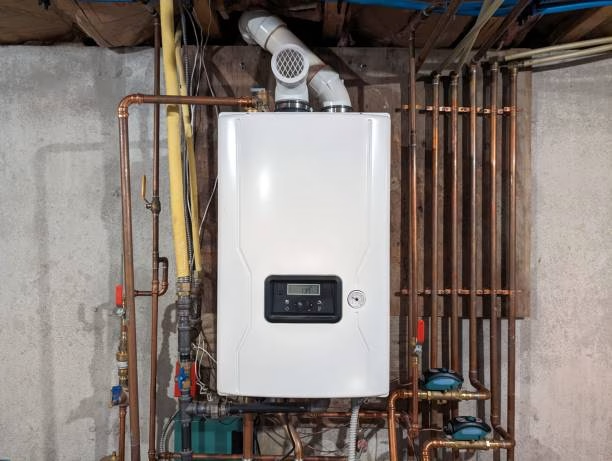
The most critical step in tankless water heater installation happens before any equipment arrives at your home. Proper sizing is essential because unlike a tank unit that stores a reserve of hot water, a tankless unit must be capable of heating water fast enough to meet your peak simultaneous demand. We calculate the maximum gallons per minute your household requires based on the fixtures you use simultaneously. A shower typically uses 2.0 to 2.5 GPM. A kitchen faucet uses 1.5 to 2.0 GPM. A washing machine uses 2.0 GPM. If your family’s peak usage involves two showers, a kitchen faucet, and a washing machine running at the same time, your tankless unit needs to deliver enough hot water to satisfy that combined demand. We also evaluate your incoming water temperature, which in our region averages around 70 degrees. The unit must raise that temperature to your desired output—typically 120 degrees. The greater the temperature rise required, the lower the unit’s effective flow rate. Our assessment also includes evaluating your gas line capacity or electrical service, determining the optimal mounting location for venting and access, and discussing your long-term plans that might affect hot water demand. For homes with existing pipe issues, our Leak Detection and Pipe Repair services address any supply line concerns before installation.
Installation
Tankless water heater installation is significantly more complex than a tank replacement and requires expertise in gas piping, venting, and combustion air supply for gas units, or heavy electrical work for electric models. Our licensed plumbers handle every aspect. For gas tankless units, we install proper-sized gas lines that deliver the fuel volume these high-BTU appliances demand. We install dedicated stainless steel venting that safely exhausts combustion gases while resisting the corrosive condensate that tankless units produce. We ensure adequate combustion air supply and proper clearance from windows, doors, and other openings per manufacturer specifications and building code. For electric tankless units, we install dedicated circuits with the proper wire gauge and breaker capacity, which often requires significant electrical work that our team coordinates. Every installation includes a service valve kit that allows the unit to be flushed for maintenance without disconnecting plumbing, a condensate drain line where required, and proper water treatment considerations for our local water conditions. We register your warranty, explain the maintenance schedule, and demonstrate the unit’s operation. For whole-house plumbing upgrades, our Whole House Repiping team can replace aging pipes alongside your tankless installation. For drain system maintenance, our Drain Cleaning services keep your waste lines flowing freely.
Gas vs. Electric Tankless
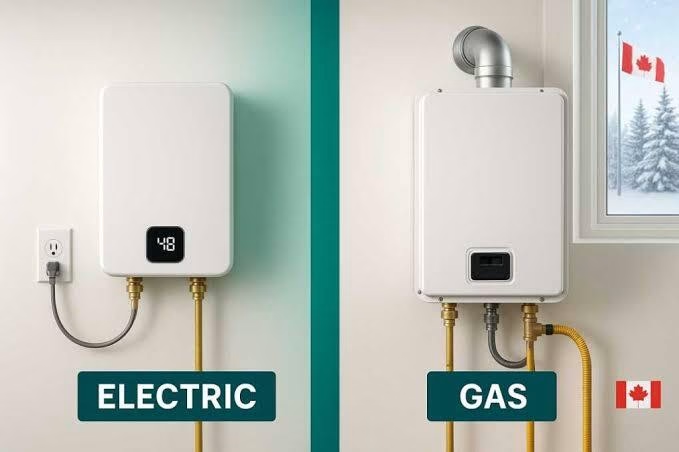
Choosing between gas and electric tankless technology depends on your home’s existing infrastructure, your hot water demands, and your energy priorities. Gas tankless units deliver higher flow rates—typically 5 to 10 GPM—making them suitable for whole-house applications in larger homes. They require an adequately sized gas line, which may need upgrading from the meter to the unit location, and dedicated venting. The operating cost is generally lower than electric tankless due to natural gas pricing, but the installation cost is typically higher due to the gas and venting work required. Our Gas Line Installation and Repair service handles any gas line upgrades needed. Electric tankless units are more compact, require no venting, and have lower installation costs in homes with adequate electrical capacity. However, they deliver lower flow rates and may struggle to meet whole-house demand in colder months when incoming water temperature drops. They’re often ideal for point-of-use applications—a single bathroom, an addition, or a workshop—or for smaller homes in warmer climates. We discuss these trade-offs during your assessment and help you select the technology that best fits your household’s needs and budget. For ongoing maintenance after installation, our Plumbing Repair team provides annual descaling services that prevent mineral buildup in your tankless heat exchanger. For sewer line concerns, our Sewer and Water Line Services team addresses underground drainage.
The Benefits of Going Tankless
Why Homeowners Are Making the Switch
The advantages of tankless water heating extend beyond endless hot water. Energy efficiency is the most immediate financial benefit. By eliminating standby heat loss—the energy wasted keeping a tank of water hot around the clock—tankless units reduce water heating costs by 30 to 50 percent. The Department of Energy estimates that homes using 41 gallons or less of hot water daily can achieve 24 to 34 percent greater efficiency with a tankless unit. Longevity is another significant advantage. While a standard tank water heater lasts 8 to 12 years, a properly maintained tankless unit typically lasts 20 years or more. The absence of a stored water tank eliminates the risk of tank corrosion and the catastrophic leaks that end a tank unit’s life. Space savings matter in many homes. A tankless unit mounts on a wall—often outdoors in our climate—freeing up the floor space that a tank unit occupies. For homes where square footage is at a premium, reclaiming that utility room or garage space is a meaningful benefit. For commercial applications, our Commercial Plumbing services install commercial tankless systems for businesses. For new home construction, our New Construction Plumbing service integrates tankless technology from the ground up. For water quality improvements, our Water Filtration Systems service addresses the mineral content that affects tankless performance.
Why DWC Plumbing Is the Right Choice for Tankless Water Heater Installation
Expert Sizing Prevents Disappointment. The most common complaint about tankless water heaters—insufficient hot water—is almost always the result of improper sizing, not a flaw in the technology. We calculate your specific peak demand, measure your incoming water temperature, and specify a unit that will meet your household’s needs. We’d rather tell you honestly that a particular unit won’t work for your situation than install it and have you disappointed.
Licensed Installation, Full Warranty Protection. Tankless water heater warranties are contingent on professional installation by licensed contractors. Our installations meet every manufacturer requirement, every building code provision, and every safety standard. We pull all necessary permits, schedule and pass all required inspections, and register your warranty on your behalf. You get the full protection of the manufacturer’s warranty plus our workmanship guarantee. For kitchen and bath renovations that include tankless installation, our Kitchen and Bathroom Plumbing service coordinates fixture and water heating upgrades. For emergency hot water situations, our Emergency Plumbing service provides rapid response.
Schedule Your Tankless Water Heater Installation Today
If you need professional plumbing services in Lake Butler, DWC Plumbing is ready to help. From repairs and maintenance to installations and emergency plumbing solutions, dependable service is only a phone call away.
Frequently Asked Questions About Tankless Water Heater Installation
Is a tankless water heater really worth the higher upfront cost?
For most households, yes. While a tankless unit costs more to purchase and install than a standard tank, the energy savings of 30 to 50 percent annually, the longer lifespan of 20-plus years versus 8 to 12 years, and the benefit of endless hot water combine to deliver a positive return on investment. We provide a cost analysis during your assessment so you can see the estimated payback period for your specific situation.
How long does a tankless water heater installation take?
Most residential tankless installations are completed in one to two days. Installations requiring significant gas line upgrades, new venting runs, or electrical panel work may take longer. We provide a detailed timeline during your estimate.
Can a tankless water heater supply my whole house?
Yes, when properly sized. A gas tankless unit with sufficient flow rate can supply every fixture in a typical single-family home simultaneously. We calculate your peak demand during the assessment to ensure the unit we install will meet your needs. For very large homes with high simultaneous demand, multiple units can be installed in parallel.
Do tankless water heaters require maintenance?
Yes. Tankless units should be descaled annually to remove mineral deposits that accumulate on the heat exchanger. This is especially important in our region with its hard water. Our Plumbing Repair team can perform this maintenance, which takes about an hour and significantly extends the unit’s lifespan and efficiency.
How much space does a tankless water heater save?
A typical tankless unit mounts on a wall and is about the size of a small suitcase—roughly two feet tall, eighteen inches wide, and ten inches deep. This compares to a standard tank unit that occupies about nine square feet of floor space. Many homeowners reclaim an entire closet or utility room corner.
Can I install a tankless water heater outdoors?
Yes, in our climate, outdoor installation is an excellent option that eliminates venting requirements and frees up interior space entirely. We install the unit in a weather-protected enclosure on an exterior wall with proper clearance from windows, doors, and other openings.
Will I ever run out of hot water with a tankless unit?
No—that’s the defining advantage. A properly sized tankless water heater heats water continuously as it flows through the unit. As long as the total flow rate doesn’t exceed the unit’s capacity, you can run hot water indefinitely. You’ll never experience the cold shock of a depleted tank again.
Can you replace my tank water heater with a tankless unit?
Yes. We assess your existing gas line, venting, electrical service, and plumbing connections to determine what modifications are needed. Most homes can accommodate a tankless conversion with some infrastructure upgrades. Our Water Heater Repair and Replacement team can also assess whether your current tank unit can be repaired if you’re not ready for the tankless upgrade.